The Countess of Harewood's Gothic Tiara
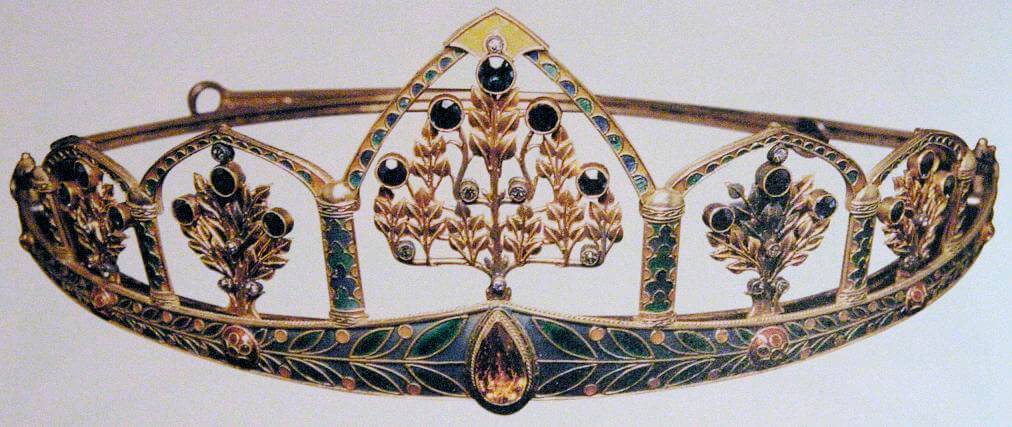
This is one of the most striking and unusual tiaras I've come across. Nothing else I've found has the same look or style. It's so exotic!
In the 1920s, jewelry designer Harry Murphy was commissioned by Queen Mary to create a tiara for Mary, the Princess Royal to commemorate her engagement to the Earl of Harewood. The tiara was sold at auction in 1966, the year after she died, for the grand sum of £462 (which would be £7,743.65 today).
Most of its history since then has been murky but in 2005 it was part of the Sataloff and Cluchey Collection, a privately held collection belonging to Joe Sataloff who was a professor of otolarynology but also internationally recognized as both an expert and collector of antique jewelry. He passed away in 2008 and I do not know if his collection is still intact. The tiara's whereabouts is unknown.
The Arts & Crafts style tiara is made of gold and decorated with colorful enamelling. He used Tree of Life motifs in this piece as he did in many of his other works. The trees are set with diamonds and sapphires and a large, pear-shaped citrine is set in the middle of the tiara's band. According to this article, the Tree represents growth, strength, renewal and continuity, making it an appropriate symbol for a tiara celebrating an upcoming marriage.
H.G. Murphy, the tiara's designer, has a fascinating story, which I've linked to below. He became very well-known as a jeweler and silversmith, influenced by the Arts & Crafts and Art Deco styles. He was lost to history for a while, though. His artistic output was hampered by both the 1929 stock market crash and World War I and he died at a fairly young age in 1939. By the time World War 2 had ended, styles and design aesthetics had changed. His work faded into obscurity until it went through something of a resurgence, thanks in part to the attentions of Paul Atterbury and Jon Benjamin, former consultants on the BBC's Antiques Roadshow and enthusiasts of his work.

- The Arts & Crafts Movement: A Revolution in Jewelry Design - Article from DSF Antique Jewelry explaining the Arts & Crafts artistic trend.
- Sapphire Gothic Tiara-Mary Princess Royal Jewellery - Article about the Gothic Tiara from Ursula of the Royal-Magazin website.
- Joseph ‘Dr. Joe’ Sataloff, 89, Art Nouveau Jewelry Expert
- The Forgotten Falcon - Biography of H.G. Murphy, designer of the Gothic Tiara.
- Paul Atterbury - Antiques Expert
- John C. Benjamin - Biography
When I first started using Zonelets I had Disqus set up as a commenting system but it looked obnoxiously ugly and I ditched it. Some people are happy to not have blog interaction but I'd love to hear from you if you have any thoughts you want to share! You can respond through my guestbook or email. If you found this link on Discord or the 32-Bit Cafe Discourse, you can message me there or leave a message on my Neocities profile page.