A Ruby Tiara Duo for July
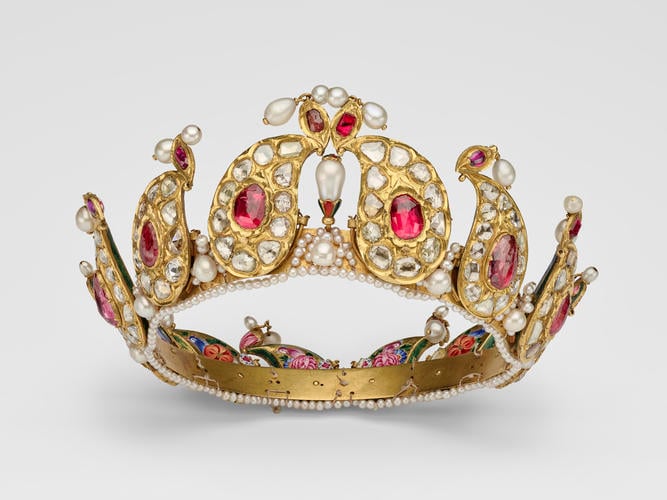
Muscat Tiara | source
July's birthstone is the ruby so let's take a look at a couple of ruby tiaras this week.
In 1838, Queen Victoria was given this tiara by a representative of the ruler of Muscat (the capital of Oman) in recognition of her recent coronation. From the Royal Collection Trust website:
On 30th August 1838, an Envoy of Sayyid Sa’id, the ruler of Muscat, presented several gifts to Queen Victoria to mark her coronation two months earlier. Among them was this unusual ‘tiara of Persian stones’ (QV Journal, 30 August 1838). Muscat had strong trading connections with Qajar Iran and the tiara was probably made to commission. A similar piece is described in the memoirs of Sayyid Sa’id’s daughter Salame (later Emily Reute) as having been ordered for her elder sister. She records ‘my father made her a present of a splendid and very precious crown, which he had expressly ordered from Persia for her. This magnificent diadem was made of golden palm leaves, richly set with diamonds, decreasing in size from the large centre stone. It was of a shape that could not be worn with our head-dress, and it was intended more as a valuable investment in case of need’.
The coronet comprises twelve boteh-shaped gold panels mounted onto a gold band, the outer faces of which are encrusted with large rubies encircled by diamonds, with a smaller ruby set into a leaf shape at their tips. Polychrome enamel panels in three designs (a young female figure in Qajar attire, a young male figure in Regency costume and a rose-and-nightingale motif) decorate the reverse sides. Queen Victoria had the piece reset by the London jewellers Kitching & Abud and it is likely that the smaller seed pearls and upturned drop pearl at the centre were incorporated into the design at this point, possibly re-used from the two pearl necklaces also presented by Sayyid Sa’id to the Queen in 1838.
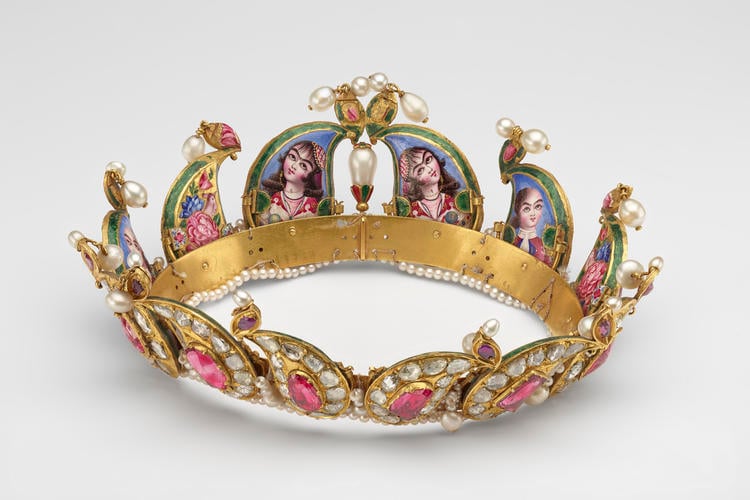
Here you can see some of the enameled images. If you go to the source link, there are more pictures of the individual panels. The human figures don't change but there are 3 different rose and nightingale images.
Prince Albert tinkered with the design and Queen Victoria had it reset at some point so it sounds like it was actually worn and not just kept as a display. It's so strikingly different from her other tiaras. I wonder what kinds of outfits and during which occasions she wore it.
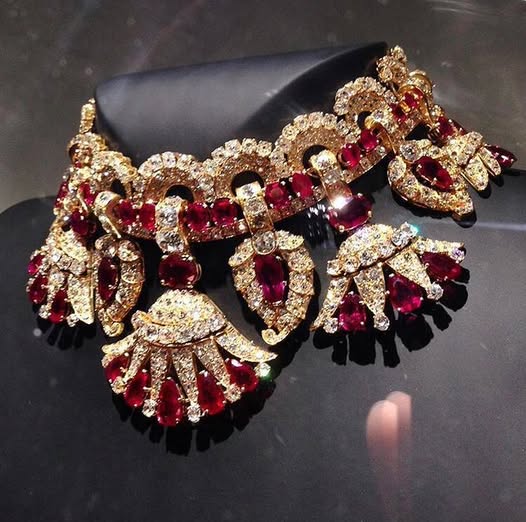
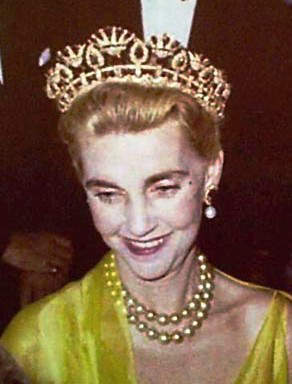
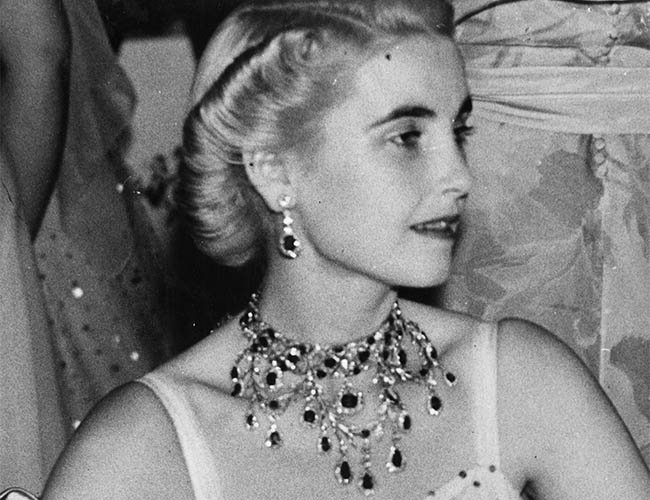
Wait a minute, you're saying. You can't fool us, this is clearly a necklace! Well, yes, it is but it converts into a tiara. The best pictures I could find were of it in necklace form so that's what I wanted to lead with. I could only find a couple of tiara pictures and they were not the greatest, as you can see below. You can see a photo of Barbara wearing the necklace over at the Royal Magazin site.
Vincent Meylan is a French journalist and historian who specializes in writing about jewels. According to him, the necklace was originally made by Chaumet in 1910 for Hutton's mother and looked markedly different from the current necklace.
The necklace before it was redesigned | source
There is a letter in the Van Cleef & Arpels archives stating Barbara wanted her rubies reset in a yellow gold setting, so this necklace/tiara is an entirely 1940s creation from Van Cleef & Arpels. After Hutton died it was bought privately and wasn't seen again until it showed up at a private Van Cleef & Arpels jewelry exhibition, where Victor Meylen saw it. Apparently he got to hold it and I am so jealous! - source
You'll find some sources on the web that state this necklace belonged to Queen Amelie of Portugal but that is incorrect. Meylan says there is no documentation at all proving that and I'd believe him since he is an expert.
I love how incredibly, satisfyingly chonky this tiara looks. I wonder if it was very heavy. It doesn't look to me like a particularly 1940s style of jewelry, though. I wonder where Van Cleef & Arpels got the design idea from. There's no indication that Barbara had any input other than wanting her rubies reset in gold.

- What Happened to the Qajar Dynasty of Iran? - One of the enameled portraits on the Muscat Tiara is described as having a young female in Qajar attire. I had not heard of the Qajar until researching this tiara. Here's some interesting info on the Qajar Dynasty.
- Persian Rose-and-Nightingale Paintings - There's a reason several of the Muscat tiara panels have a rose and nightingale theme! Super interesting dive into the history of this motif.
- Inside Barbara Hutton’s Legendary Diamond Collection - Fascinating article about her jewel collection, which does not show this tiara but does show her other tiara plus some other fabulous jewelry.
- Ruby Gemstone - All about rubies from the Gemological Institute of America
- The Tragic Life Of Barbara Hutton - Barbara Hutton may have had fabulous jewels but her life was a train wreck. She went through 7 marriages, lost her only child and died practically penniless despite being the world's richest woman at one point.
When I first started using Zonelets I had Disqus set up as a commenting system but it looked obnoxiously ugly and I ditched it. Some people are happy to not have blog interaction but I'd love to hear from you if you have any thoughts you want to share! You can respond through my guestbook or email. If you found this link on Discord or the 32-Bit Cafe Discourse, you can message me there or leave a message on my Neocities profile page.