Emerald Tiaras for May
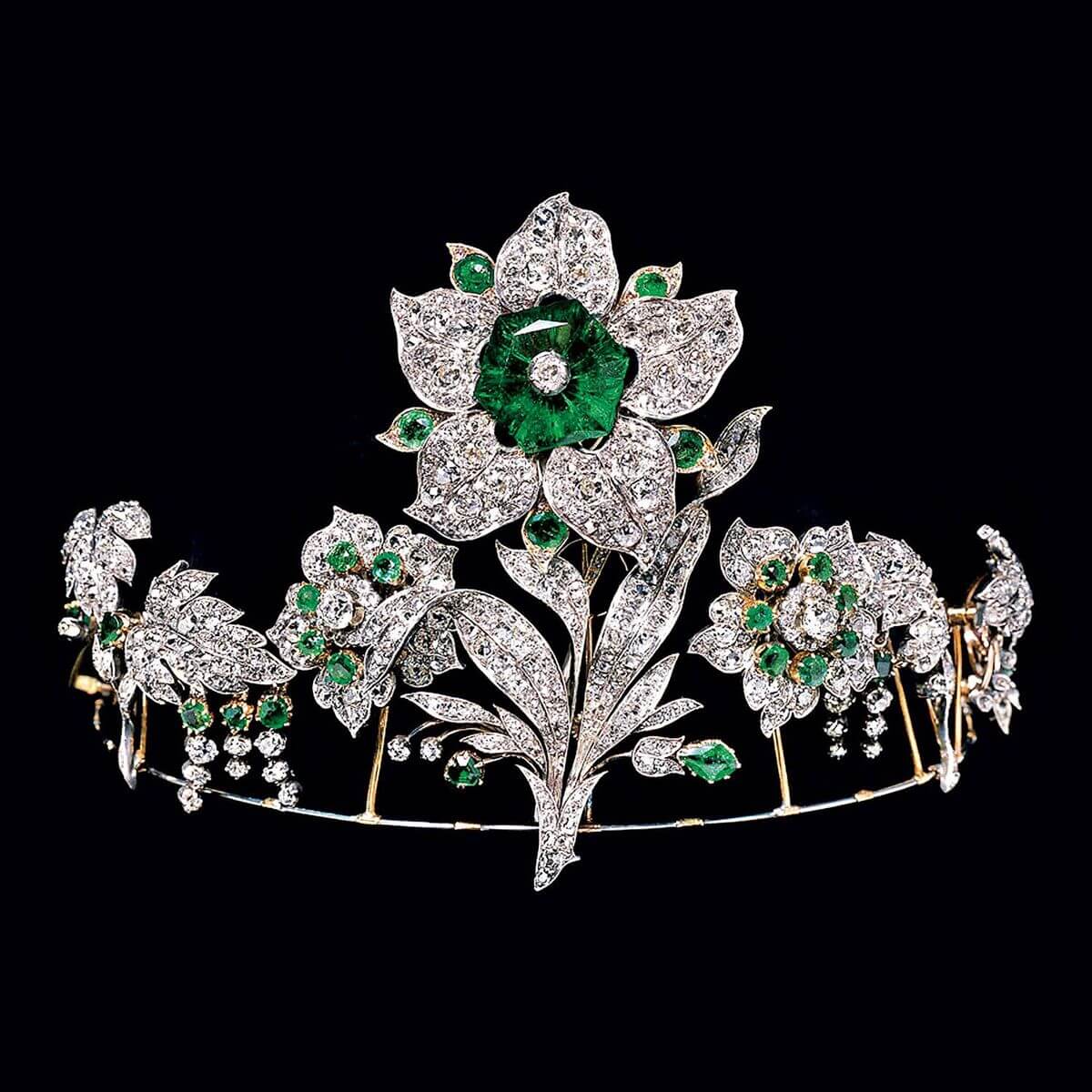
Since it's May, we're going to take a look at some tiaras featuring emeralds! Now, I know, this first one is kind of diamond-y. Actually, several of them will be. But look at that huge central in-your-face flower!
This is the Leuchtenberg Diadem, made circa 1830-1840 by Jean-Baptiste Fossin, who was known for his diamond floral arrangements. It is set with 698 diamonds and 32 emeralds, one of which is that honking huge hexagonal emerald, weighing in at 13 carats. That huge flower, which is supposed to be a narcissus, is set en tremblant (on a set of springs so it shakes at the slightest movement).
You all know how much I like a convertible piece of jewelry. All 8 of these floral motifs detach and can be worn as brooches or in a hairdressing ornament. In addition, there is a second frame that allows all the elements to be arranged on the front of a dress's bodice.
This is the first tiara I'm covering that has its own dedicated Wikipedia page! There is some additional information on the page that is interesting, so it's worth a visit. I'll put the link in the rabbit hole.
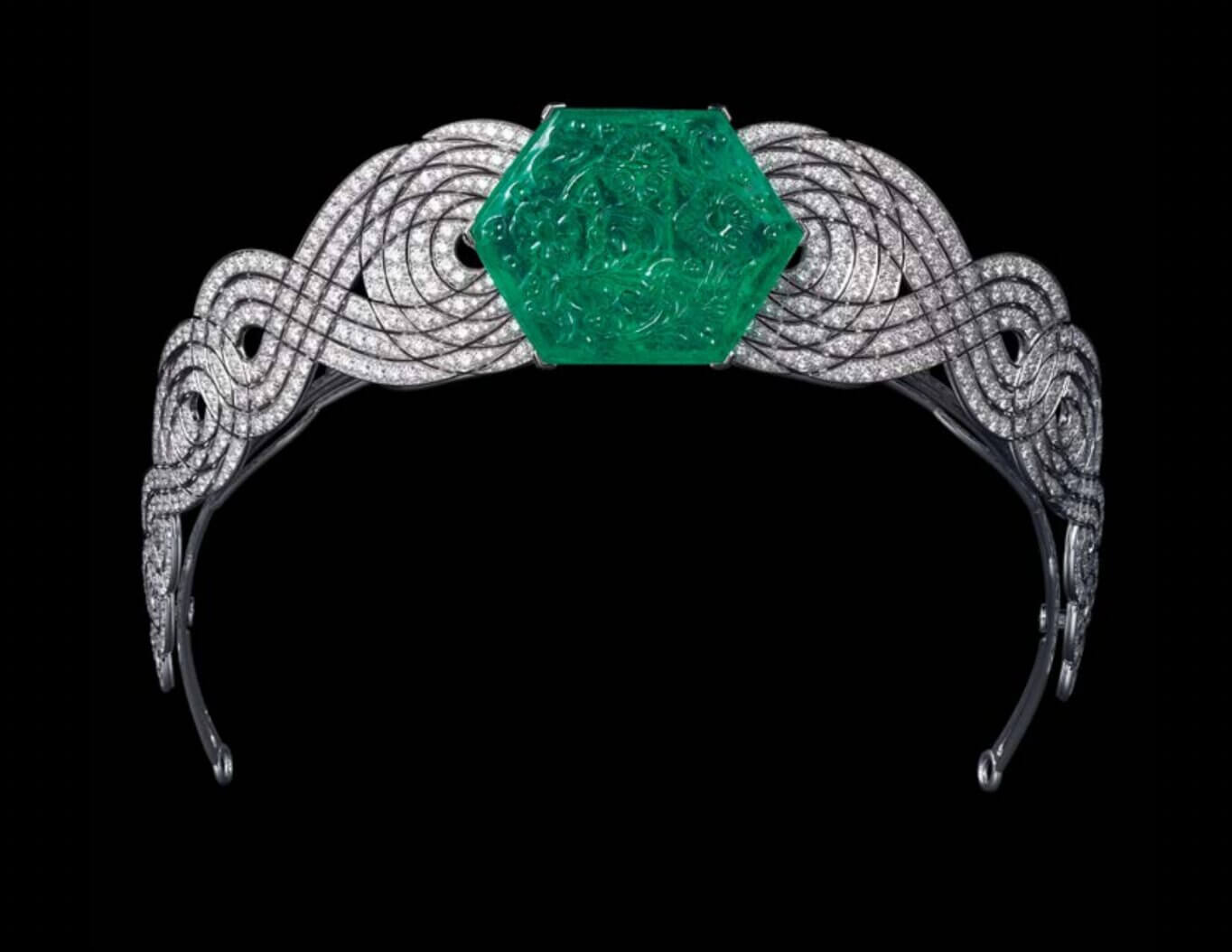
The star of the show here is really the emerald. The tiara was made by Cartier fairly recently, in 2012, specifically to feature the emerald which has quite a history of its own! I've included a close-up so you can get a good look at the beautiful carving.
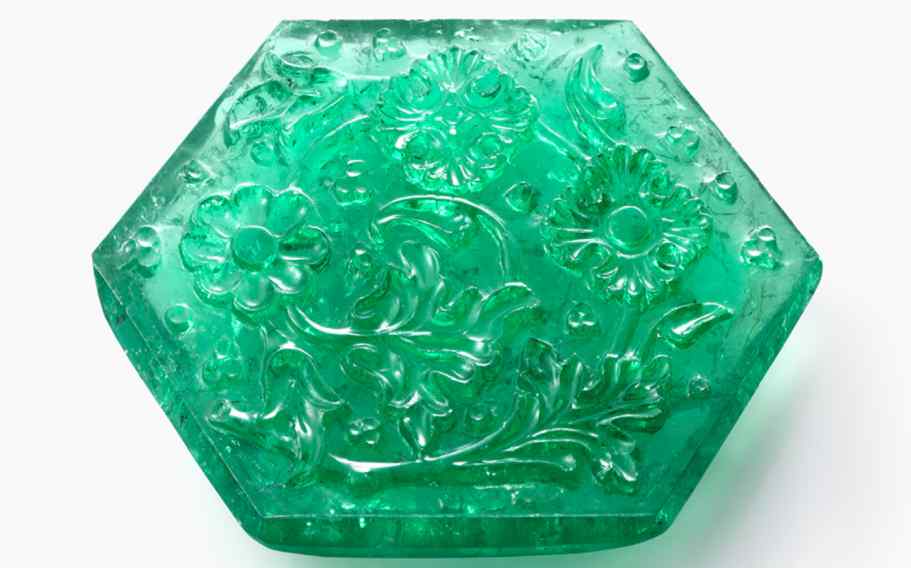
It is known as the Bérénice Emerald and was likely carved during the reign of the Mughal emperor Shah Jahan (1592-1666). According to Richard Jean-Jacques, who runs a fascinating blog dedicated to the history of Parisian jewelers, jewelers and manufacturers of the 19th and early 20th centuries, this emerald was
Born in the mines of Chivor, Muzo or Coscuez – cradles of emeralds – in Colombia and extracted by the Conquistadors, in the XVIth, it was transported to Seville, transited through Lisbon, made a stopover in Goa – India counter – to reach Jaipur in Rajasthan in order to be engraved in the royal workshops.
He has a lot of other cool information about the emerald that you would probably find interesting, like even more history than I'm relating here, pictures, why it was called the Bérénice Emerald. I'll put his blog link down in the rabbit hole. Anyway, the whereabouts of the emerald was unknown until Cartier showed it off at the 1925 Exhibition of the Arts. They had the emerald set into a shoulder jewel. The page this information is from is in French and I thought that might have been a bad translation but, no, they actually made a jewelled piece that draped around both shoulders, like so:
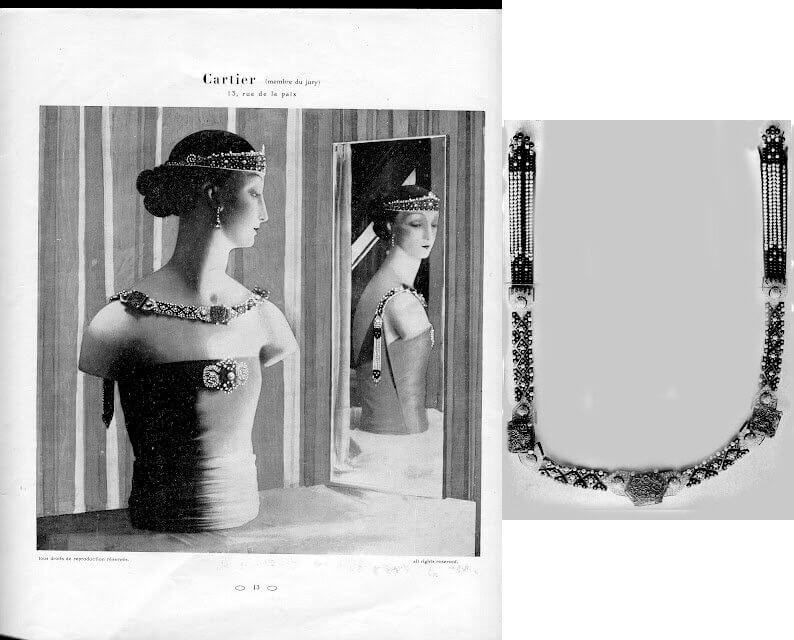
I don't know if shoulder jewels were ever really a style but I think they need to become one. The shoulder jewel was dismantled and the emerald was sold in 1927. It disappeared from history once again until it was sold at a Christie's auction in 2009. And sometime in between 2009 and 2012, it made its way back to Cartier where they had this tiara created to showcase it.
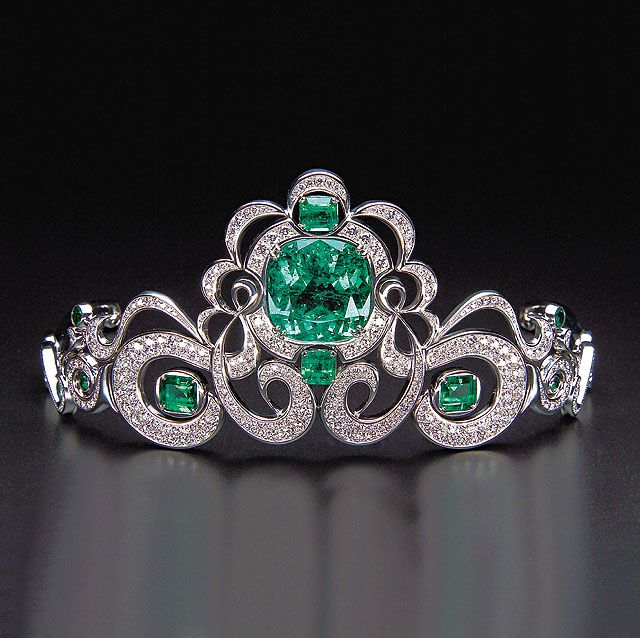
Once again, the real star of the show here is the 42 carat emerald and the platinum and diamond tiara was created in 2005 to specifically show off the stone. I think this is much more visually interesting than the previous one. You can find this in the Houston Museum of Natural Science's Cullen Hall of Gems and Minerals as part of the Lester and Sue Smith Gem Vault. The designer of the tiara is Houston jeweler Ernesto Moreira and it is apparently his job to create beautiful jewelled settings for some of the gems in the vault. That's so cool!
I have to quote this from an article I'll link to below because it just fascinates me:
While Cullen Hall showcases the raw materials, the Smith Gem Vault displays expertly cut, polished and mounted specimens gathered during a 10-year global treasure hunt directed by museum president Joel Bartsch and Lester and Sue Smith, museum board members and benefactors. "We always had plans to do this," Lester Smith says. "Along the way we would pick up a loose piece here and a loose piece there."
I don't know what the reality was but I am imagining Romancing the Stone levels of gem acquisition.
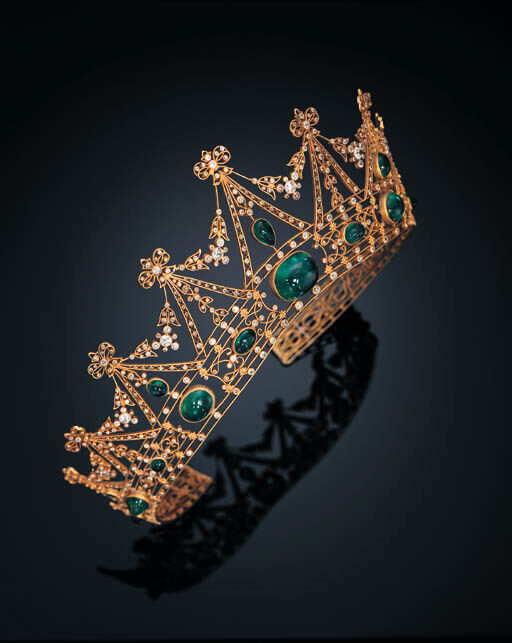
Such an interesting piece! I can find no other pictures or information on this tiara, only what's available on Christie's auction site. I love the look - it falls into what I call "proper princess tiara" territory. Created circa 1905 by Tiffany & Co., it is made of gold with cabochon and pear-shaped emeralds and diamond collets. The site doesn't list the date sold (or who it went to) but it went for $34,500.
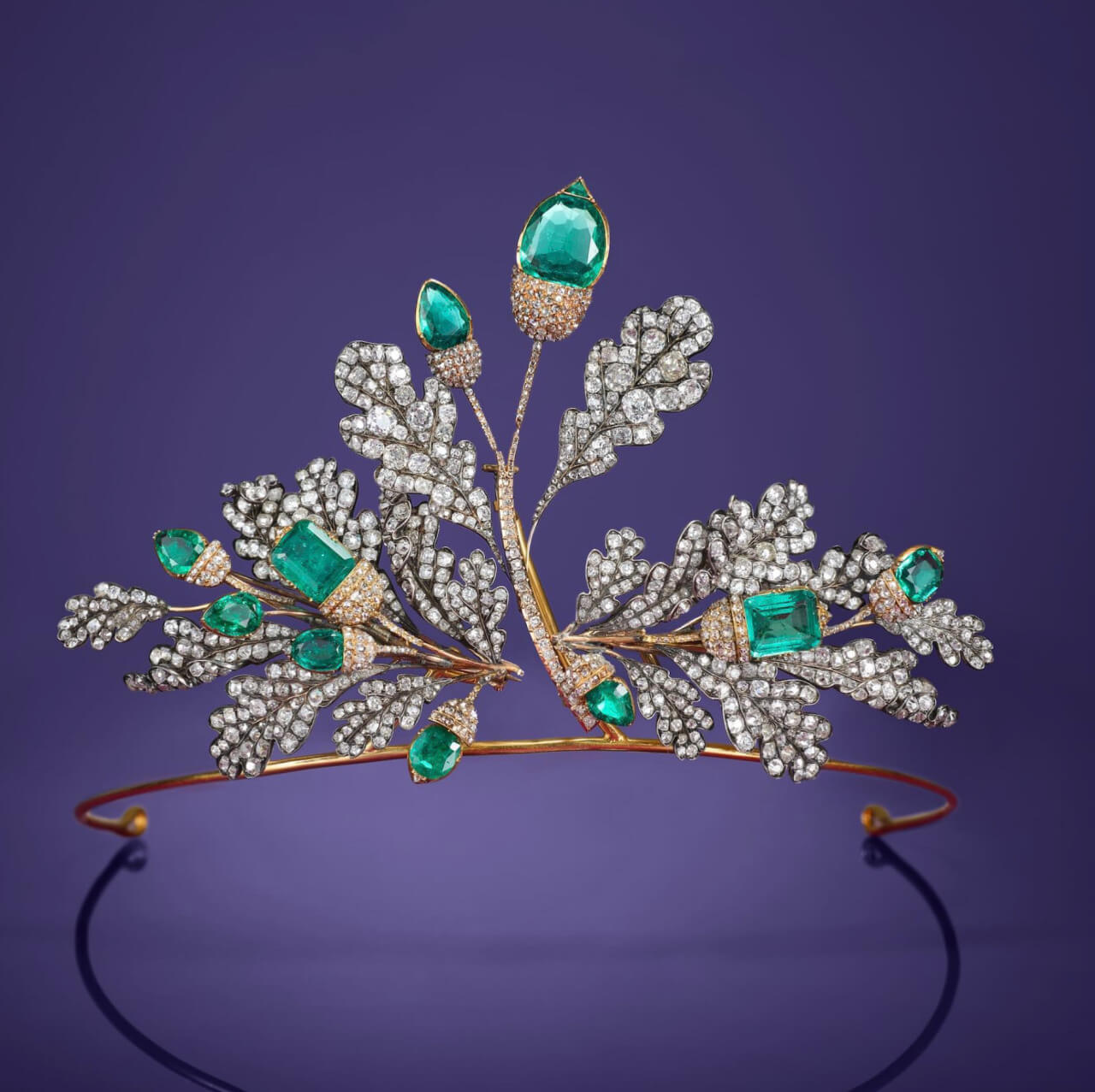
Created around 1840-1850, this is another convertible tiara. The leaves detach to become 3 brooches. I love those emerald acorns! I have found no information on who made the tiara or any other history on it. Boylerpf, a jewelry store that specializes in both modern and antique jewelry, posted a picture of the tiara on their Tumblr and had this to say about the symbolism:
In Europe, the resilient nature of the oak tree is regarded as a symbol of royalty, while acorns represent the protected people.
It is currently part of The Illuminata Collection and has traveled the world to be in various exhibitions. The Illuminata Collection is owned by one person who wishes to remain anonymous and, despite having a trove of beautiful jewels, doesn't consider herself a "collector." Also, this information is from an interview with Nicolas Luchsinger, the President of Van Cleef and Arpels Asia Pacific, and he says the not-a-collector is "...one of the world's leading experts in the field of classical Chinese furniture, renowned and highly respected for her extensive and top-quality collection." which kind of sounds to me like he just outed her? I'll link to the interview, it is quite interesting and there are other jewel photos.
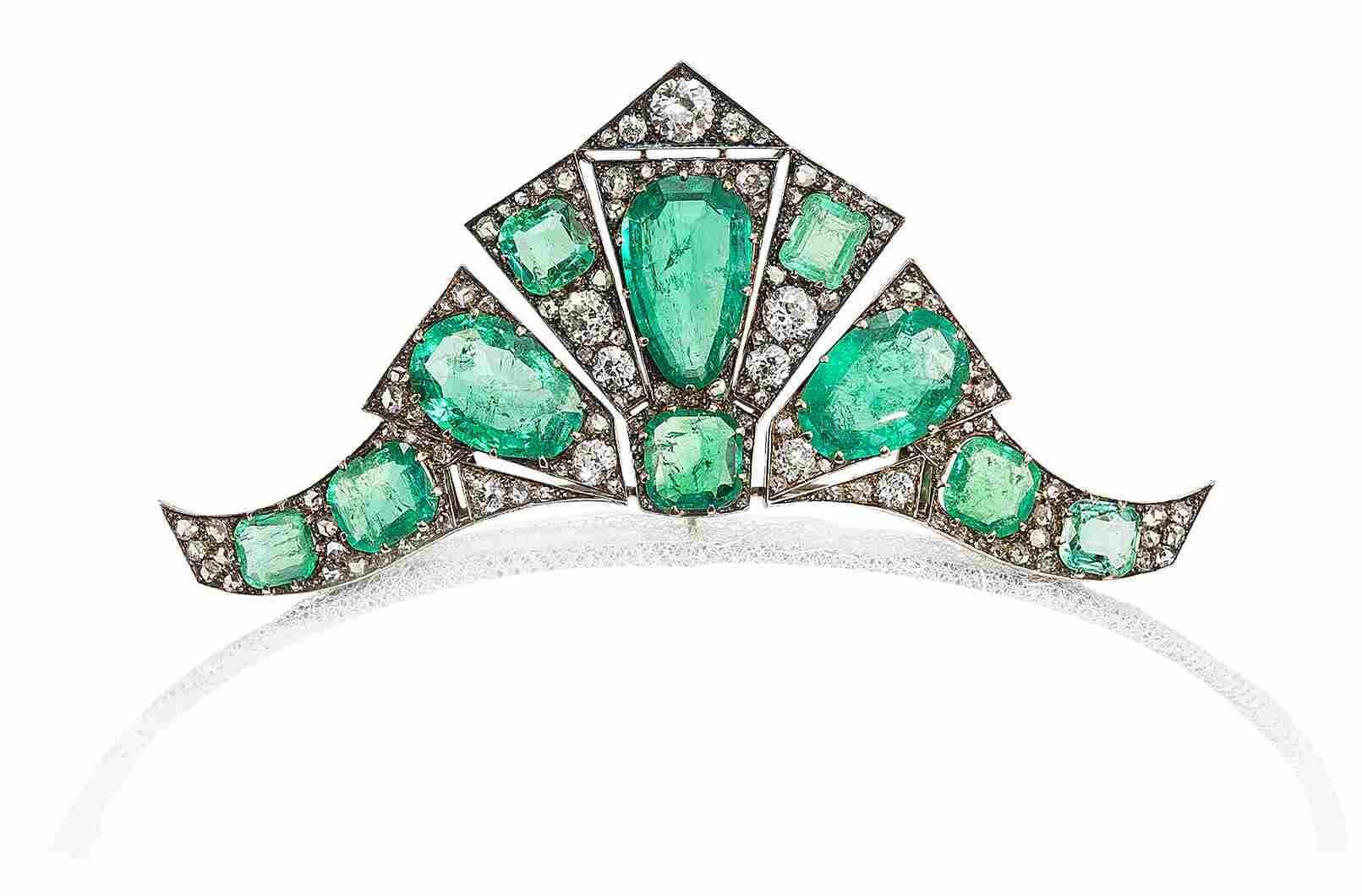
For our last tiara of the post, we have this lovely Art Deco piece made around 1935. It came with a fitted case from Carrington & Co so I'm going to assume they were the makers. It's made of silver and gold with emeralds and old brilliant and rose-cut diamonds. It was sold at auction by Bonham's in 2012 for £11,875 (equivalent to £17,499.41 in today's pounds). It's convertible into a brooch and double clips. There is an interesting tidbit of information on the auction site regarding the provenance of the emeralds that you might want to go read. Clicking on the source link of the photo will bring you to that page.
I hope you have enjoyed this roundup of emerald tiaras!

- Jean-Baptiste Fossin - (Wikipedia, in French)
- Leuchtenberg Diadem - (Wikipedia, in French)
- International Exhibition of Modern Decorative and Industrial Arts (1925) - (Wikipedia)
- Precious Jewelry and Stones: Cartier's "Bérénice" Necklace for the 1925 Exhibition: Unsold and dismantled - Fascinating blog post (in French) about the Bérénice Emerald
- Cullen Hall of Gems and Minerals
- Natural Science museum opens up vault doors of exhibit - article about the Lester and Sue Smith Gem Vault
- From Stone to Setting: Gem Vault, Behind the Scenes - Flickr photo album showing Ernesto Moreira's workshop.
- What is a collet setting?
- An Eye for Beauty: Conversation with curator Nicolas Luchsinger, President of Van Cleef & Arpels Asia Pacific, on the mysterious Illuminata Collection
- Emerald: The bright green gem of the beryl mineral family and May birthstone
When I first started using Zonelets I had Disqus set up as a commenting system but it looked obnoxiously ugly and I ditched it. Some people are happy to not have blog interaction but I'd love to hear from you if you have any thoughts you want to share! You can respond through my guestbook or email. If you found this link on Discord or the 32-Bit Cafe Discourse, you can message me there or leave a message on my Neocities profile page.