Tiaras as Art: Jan Yager
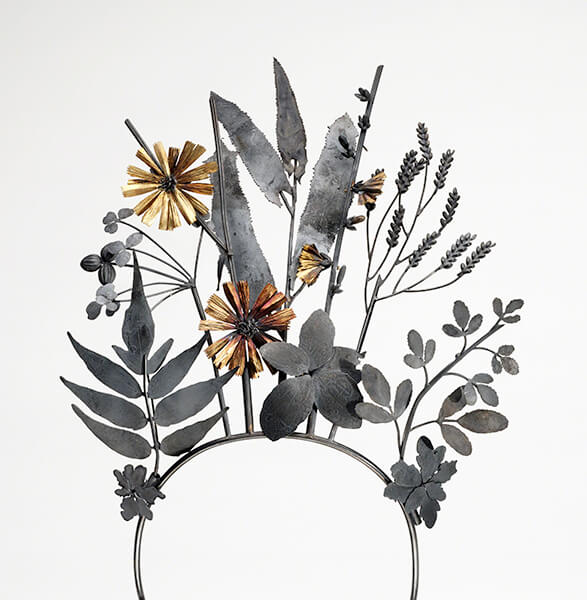
American Tiara: Invasive Species (2001)
American artist Jan Yager (1951-2024) created many pieces of jewelry and other artworks throughout the years but only 2 tiaras. They were part of her City Flotsam/City Flora series, which had objects created from both garbage found on the sidewalks around her Philadelphia art studio (such as crack vials, coins, syringes, pen tops, buttons, etc) and plants growing both through the sidewalks and in a nearby field. American Tiara: Invasive Species was the first one created, in 2001, and was eventually part of an exhibit at the Victoria and Albert Museum. Today the piece resides at the Philadelphia Museum of Art.
I have very little plant knowledge and I can't find a lot of detailed descriptions of this tiara so I have no idea what all the plants on the tiara are although I believe the gold flowers are chicory. The botanical elements are created from oxidized silver and gold and the tiara can be taken apart so the pieces can be worn individually. Apparently Jan was surprised to find out that so much of the plant life right outside her studio door was not native, hence the name of the tiara.
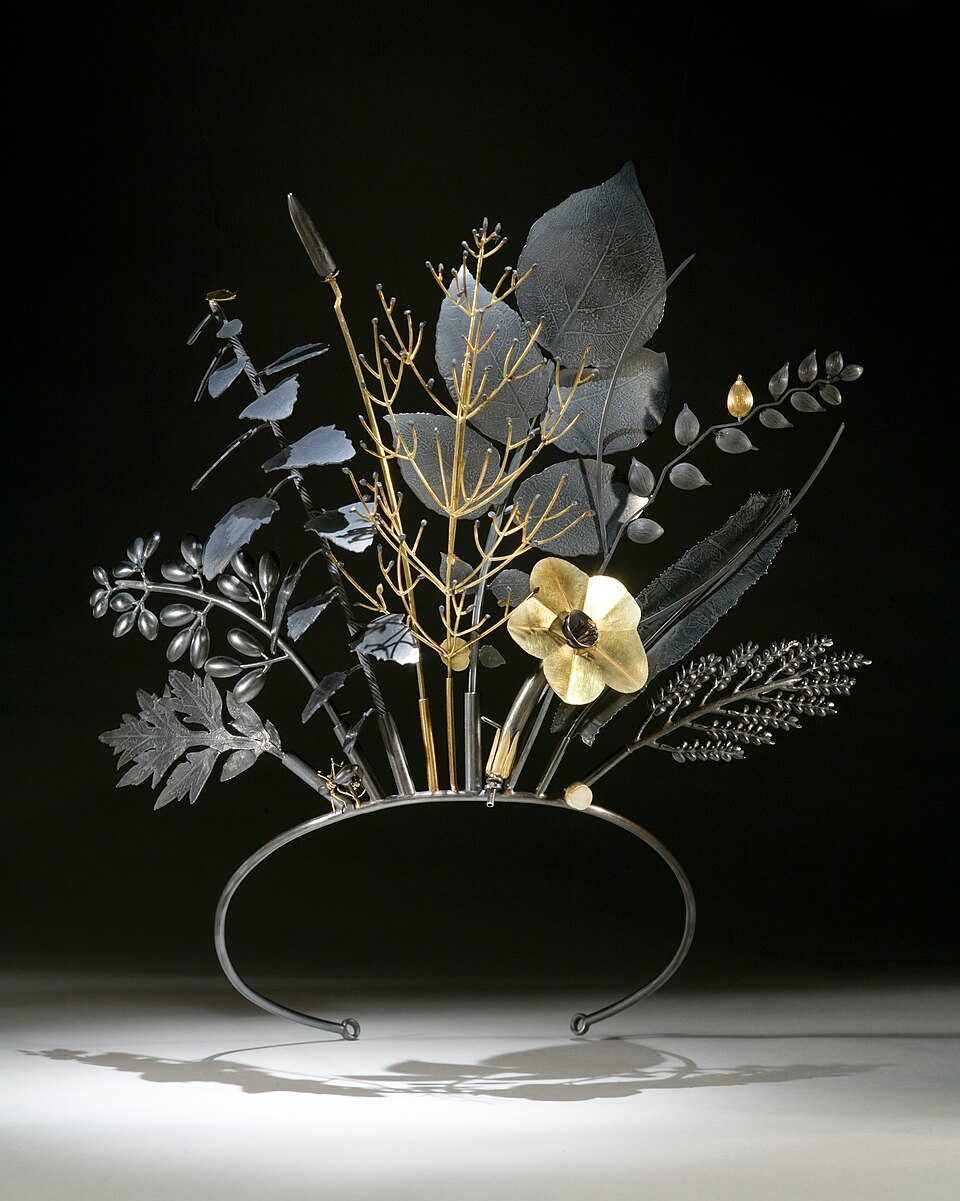
source | CC BY-SA 4.0, via Wikimedia Commons
After the City Flotsam series, Yager created the City Flora series, part of which was the Tiara of Useful Knowledge, made in 2006. As with the first one, it was made of oxidized silver and gold and can also be taken apart. Separated, the pieces turn into 8 brooches, 2 stick pins, a tie tack, a pendant and a headband. On the wikimedia page that this image file is from there is also a vey detailed description of the tiara, written by Yager. It is absolutely fascinating and I am just going to quote it entirely here for you all to read:
THE TIARA OF USEFUL KNOWLEDGE is the visual synthesis of research into readily available plants. Studying the vegetation in the vacant lot near my studio and behind my Philadelphia row house began as a search for new forms and textures for jewelry, and resulted in a deep appreciation of the genius of Nature. Tiaras are rooted in the practice of placing laurels upon the heads of victors in ancient Greece, and grew into an icon of British royalty. My American version is modeled after common weeds that I thought were unique to the USA until I read about Invasive Species – and Aliens pushing out Natives. Natives were now Rare, Threatened, Endangered, Vulnerable, Extinct or even Extirpated. My beloved City Flora – were being described as Nuisance, Noxious, or Worst.
The Tiara of Useful Knowledge focuses on the Importance of plants. It is inspired by The American Philosophical Society’s charter [1743] “for Promoting Useful Knowledge,” and the Academy of Natural Science’s [1812] goal “to connect people to nature.” Composed of portraits of ten plants, an ant, and a pebble chosen for their “usefulness” and to celebrate the diversity and interdependence of plants, animals, and minerals. Designed as a “transformer” it can be used (or displayed) as a tiara, or the 12 pieces of jewelry can be removed and worn separately. Made of oxidized sterling silver, 18K, and 14K gold, and employing numerous metal working processes.
A Potato Leaf (I call it a French Fry Leaf) symbolizes the importance of biodiversity. It is modeled after a sprouted potato my 13 year-old daughter stuck in a bucket of dirt in the backyard, that rapidly grew and yielded potatoes. Native Americans were cultivating nearly 3,000 varieties of potato at the time of the Spanish Conquest [1535]. Only a few were brought back to Europe, spawning the monoculture that led to the Irish Potato Famine [1845-1850]. Today, there are still reportedly thousands of edible plants, yet once again we rely upon 20 or so for most of our food, and their industrial growers talk of patenting those.
Lamb’s Quarter’s is included because of its dual identity. A typical plant is said to yield many thousands of seeds able to remain dormant for 40 years making it highly resistant to chemical herbicides. The makers of herbicides label it the “World’s Worst Weed.” But, since it is one of the first plants to grow back in disturbed soil, and is more nutritious than most standard crops, others list it as a “Plant for A Future.” One Hurricane Katrina survivor confirmed this when he found it the only useful (edible) thing on the site where his house once stood!
Switch Grass reminds us that important things are hidden in plain sight. And, that renewable sources of fuel for our cars grow freely on the North American prairies. Clover, Plantain, Rye, Prickly Lettuce, Crab Grass were each selected for the food, shelter and/or enrichment of all sorts they offer animals, the environment – and us. The American Tobacco blossom represents the powerful seduction of cash and addictive crops, and Ragweed the powerful and sometimes deadly allergens, poisons and medicines found – sometimes in the same plants.
Benjamin Franklin encouraged the pursuit of knowledge in diverse fields for the common good. John Bartram, (America’s first botanist) approached each new plant with curiosity and a profound belief in Nature. Thomas Jefferson embraced all vegetation trusting it had value – perhaps not yet known. These ideals – born in Philadelphia and worthy of a nation – celebrate diversity, foster tolerance – and focus our attention on Usefulness.
Jan was featured on Craft in America, a PBS series that has artists and makers describe the process of crafting their works. The video is only about 9 minutes long and a fascinating look into her thinking and her crafting process. The actual creation process is so cool - you can watch as she glues leaves onto silver sheets and then runs them through a rolling mill, which causes faint leaf impressions to become imprinted on the silver. She likens it to a printing press. I'm going to try embedding the video but if that doesn't work for some reason, you can watch it on Craft in America's site here.
- Art Jewelry Forum - Jan Yager: October 9, 1951–August 14, 2024, An Appreciation
- Beauty in Weeds and Flotsam: Jan Yager
- Jan Yager - (Wikiwand)
- Jan Yager Explained
- Jan Yager, Invasive Species Tiara
- Weeds on the Lapel: Biology and Jewelry - The first thing Jan Yager says in the Craft in America video is "I think we're the only animal that seems to need to ornament ourselves." The author of this article received an email from Jan regarding her Invasive Species tiara and then goes on to talk about the biophilia hypothesis, which ties in to her comment.
When I first started using Zonelets I had Disqus set up as a commenting system but it looked obnoxiously ugly and I ditched it. Some people are happy to not have blog interaction but I'd love to hear from you if you have any thoughts you want to share! You can respond through my guestbook or email. If you found this link on Discord or the 32-Bit Cafe Discourse, you can message me there or leave a message on my Neocities profile page.