The Mighty Coq
Lark Ascending, Public domain, via Wikimedia Commons
.jpg)
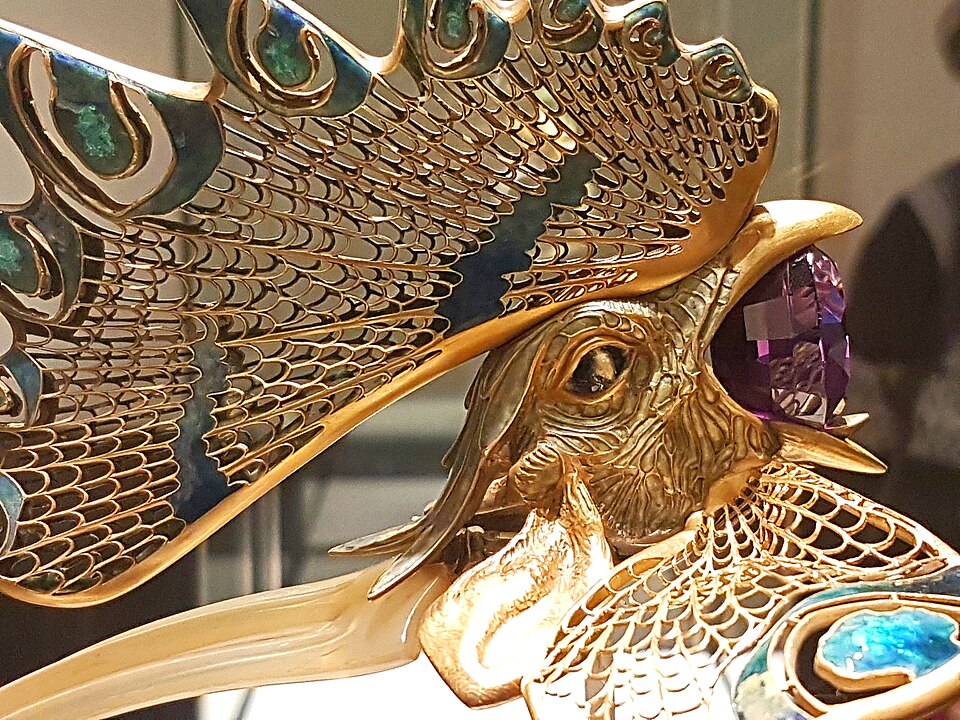
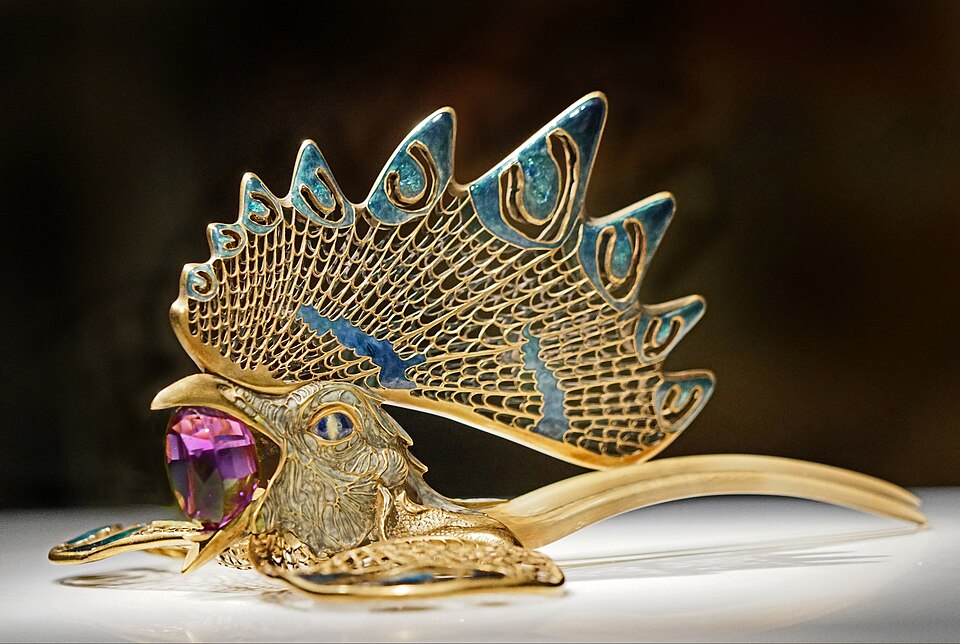
Behold! This glorious objet d'art is The Cockerel Diadem, created by Rene Lalique, a French jeweller, medallist and glassmaker, in about 1897-1898. It was displayed at the Paris Exposition in 1900.
Apparently, the piece originally had a large yellow diamond in the beak and that's how it arrived at the museum that acquired it in 1904. I have not found why or when the diamond was exchanged for an amethyst. Nor have I found out anything on its origin story. Who was it made for? Was it ever actually worn? Was it made specifically for the Paris Exposition? So many questions!
Jean-Pierre Dalbéra, CC BY 2.0, via Wikimedia Commons
,_(52171769018).jpg)
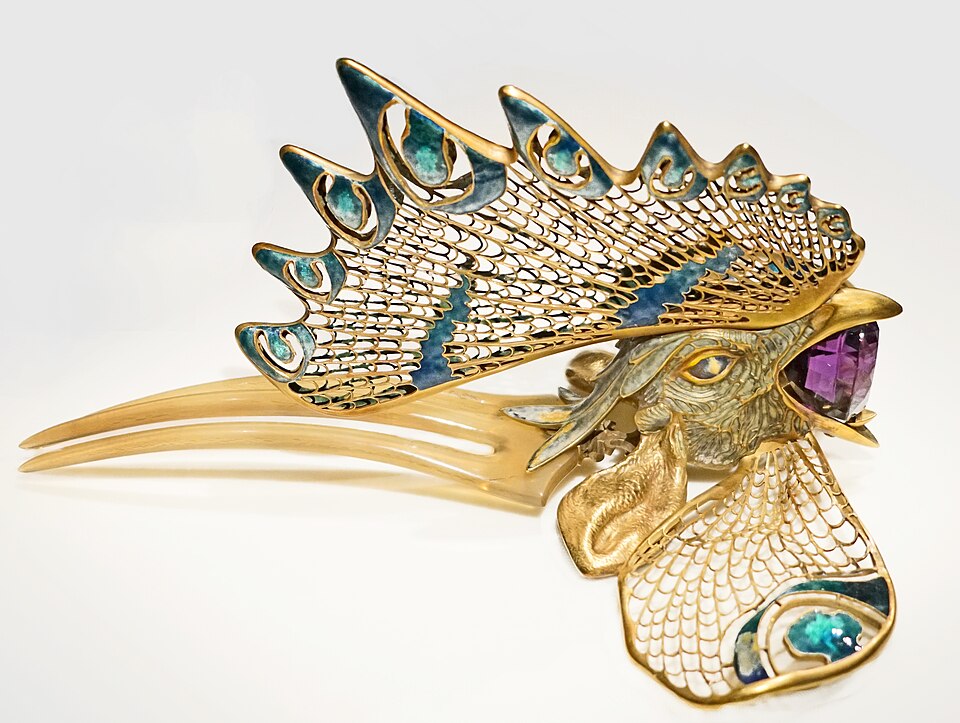
Officially, I see this referred to as a diadem and sometimes as a tiara but I think that's fudging the definition. I think of diadems or tiaras as having at least a vaguely circular shape. He is clearly attached to a hair comb and not at all circular. How would he be worn? Imagine the hairstyles of the 1900s - very poufy! I think you would have slid his comb straight through your updo and worn him proudly perched on top of your head.
Doesn't really matter what terminology is used - he is glorious and I would wear the heck out of him. (And, yes, I would probably also obnoxiously use the term coq as often as I could and then proclaim innocently, "What? It's French for rooster! What did you think I meant?")
Jean-Pierre Dalbéra, CC BY 2.0, via Wikimedia Commons
,_(52172645197).jpg)
Back to the question of why he was created - I have a theory! I think it's very possible he was created specifically for the Paris Exposition precisely because he is a rooster.
Did you know that the rooster has been used as a symbol of France? It's a play on Latin words - Gallus (an inhabitant of Gaul) and gallus (rooster or cockerel). First used as a dis against the French in the Middle Ages, the kings of France turned it into a symbol representing the triumph of good over evil. Go check out the Wikipedia article linked in the rabbit hole because it's kind of wild. Anyway, the rooster fell out of use over time as a symbol of France but came back again during the French Revolution and has been a national emblem since then.
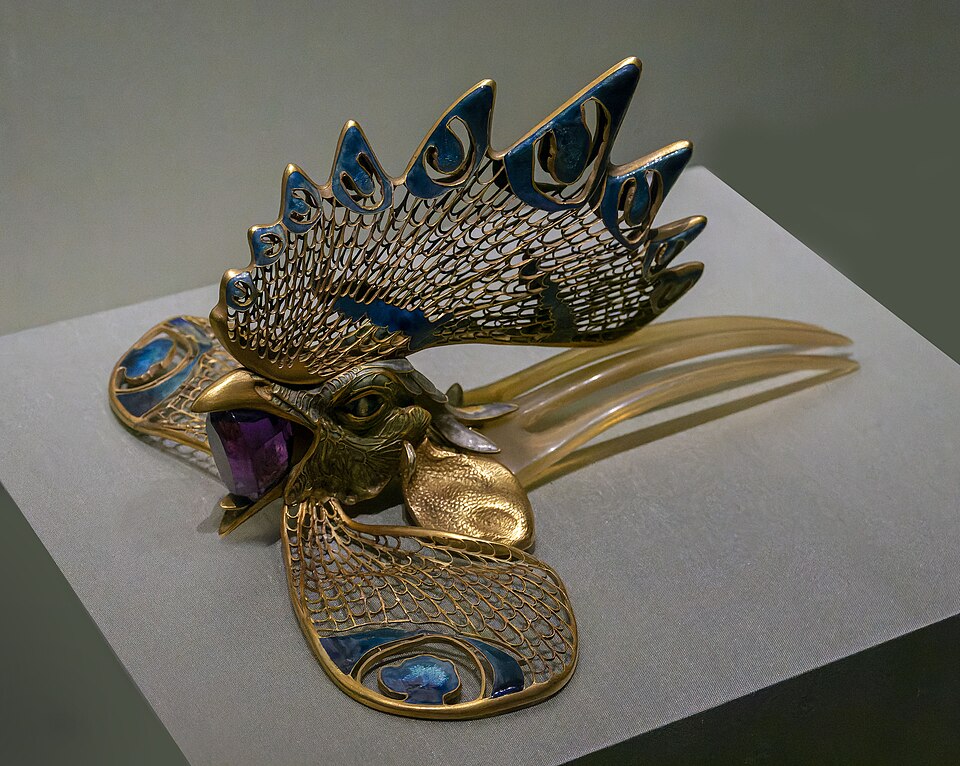
So, since it was a national emblem, it wouldn't surprise me if Lalique crafted a bespoke jewel like this for the Exposition. Let's take one last look at our fancy rooster.
Ángel M. Felicísimo from Mérida, España, CC BY 2.0, via Wikimedia Commons
.jpg)

- Chartwell’s Lalique Cockerel: A Rare Gift of Gaullist Penance - this wasn't the only time Lalique created a magnificent rooster!
- 'Cockerel' Diadem (Calouste Gulbenkian Museum)
- Exposition Universelle 1900 (Wikipedia)
- Gallic Rooster (Wikipedia)
- Heart of glass: why the world fell in love with Lalique - article focusing on Lalique's glassworks
- Know Your Backyard Chicken Terms! - What the heck is a cockerel anyway? The Old Farmer's Almanac has your back on this one.
- Renart and Chantecler: Two Animals that Shaped French Culture and Language - Find out why the Gallic rooster's name is Chantecler.
- Rene Lalique (Wikipedia)
- René Lalique and the Birth of Modern Jewelry - This is an online lecture that will be given by the Smithsonian on April 21, 2026. It will be 1 1/2 hours and tickets go on sale to the general public on February 7.
When I first started using Zonelets I had Disqus set up as a commenting system but it looked obnoxiously ugly and I ditched it. Some people are happy to not have blog interaction but I'd love to hear from you if you have any thoughts you want to share! You can respond through my guestbook or email. If you found this link on Discord or the 32-Bit Cafe Discourse, you can message me there or leave a message on my Neocities profile page.